


Table of contents
- Why Choose a Dedicated Digital Voice Recorder Device in 2025?
- Top Picks for Best Everyday Digital Voice Recorders Device (2025)
- ⭐ 1. Sony ICD‑UX570 Voice Recorder — Best Overall for Everyday Use
- 🎤 2. Sony ICD‑PX370 — Best Budget Everyday Recorder
- 🎙️ 3. Philips DVT6110 Voice Tracer — Best for Balanced Everyday Performance
- 🔊 4. OM System WS‑882 — Best for Long Battery Life & Everyday Durability
- 🧠 5. iFLYTEK Smart Voice Recorder — Best AI‑Friendly Everyday Recorder
- Key Features to Consider When Choosing an Everyday Voice Recorder Device
- Pros & Cons of Everyday Digital Voice Recorders
- Everyday Use Cases: When a Digital Recorder Shines
- Tips for Getting the Best Recording Results
- Frequently Asked Questions (FAQs)
- 1. Can a digital voice recorder replace my smartphone recorder?
- 2. Do voice recorders need external software?
- 3. How long can these devices record?
- 4. Are digital voice recorders good for noisy environments?
- 5. What formats do they record in?
- 6. Can I name files on the recorder?
- 7. Are AI features worth it?
- Conclusion
Whether you’re a student attending classes, a professional attending meetings, a journalist capturing interviews, or just someone who needs to record everyday audio clearly and reliably, a digital voice recorder remains one of the most useful devices you can own in 2025. Unlike smartphone apps, dedicated voice recorders are built for long recording sessions, intuitive control, durability, and — in many models — advanced features like noise reduction and automatic voice activation.
This comprehensive guide will walk you through the best digital voice recorder device for everyday use in 2025, explain key features to look for, compare top models, and answer frequently asked questions — so you can pick the ideal recorder for your needs.
Why Choose a Dedicated Digital Voice Recorder Device in 2025?
Even though smartphones can record audio, dedicated voice recorders remain popular because:
- 🔊 Better sound quality: Standalone recorders often offer clearer audio with less noise.
- 💾 Longer recording sessions: Designed for hours of continuous recording without taxing your phone battery.
- 📁 Ease of use: Physical buttons and simple interfaces are perfect for quick operation.
- 🔋 Long battery life: Many devices can last a full day or more of recording on a single charge or set of batteries.
- 🎙️ Specialized features: Voice activation, noise filters, and stereo microphones enhance everyday usability.
These advantages make digital voice recorders ideal for daily use across a range of situations — from meetings and lectures to personal journaling.
Top Picks for Best Everyday Digital Voice Recorders Device (2025)
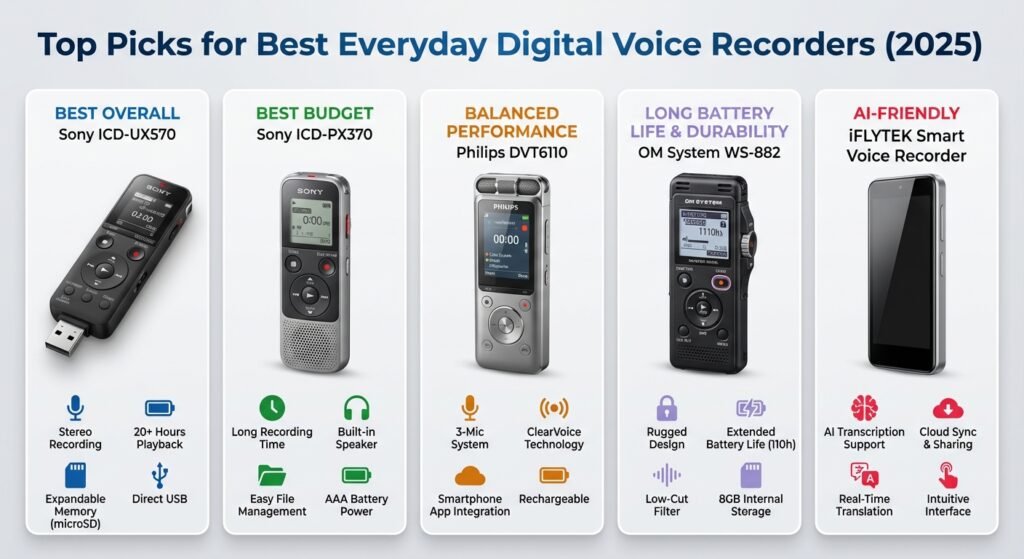
Here’s a curated list of top voice recorder devices in 2025 that strike a balance between quality, usability, and price.
⭐ 1. Sony ICD‑UX570 Voice Recorder — Best Overall for Everyday Use
The Sony ICD‑UX570 is widely regarded as one of the best everyday digital voice recorders in 2025 thanks to its lightweight form factor, ease of use, and solid audio performance. It’s perfect for students, professionals, and casual users. TechGearLab+1
Key Features:
- Ultra‑compact and portable design
- Built‑in USB plug (easy file transfer)
- MicroSD support for expanded storage
- Multiple recording modes (wide/stereo, narrow focus, normal)
- Intuitive interface with digital pitch control for playback speed adjustment
Pros:
✔ Excellent balance of performance and simplicity
✔ Highly portable and easy to operate
✔ USB plug means no cables needed
Cons:
✘ Battery life is decent but not exceptional
✘ Built‑in speaker may be weak during playback
Best For: Everyday recordings of lectures, meetings, interviews, personal notes.
🎤 2. Sony ICD‑PX370 — Best Budget Everyday Recorder
The Sony ICD‑PX370 is an ideal choice if you want a reliable, low‑cost recorder that still performs well for everyday use. It’s simple, dependable, and offers great recording time. The Best Picker
Key Features:
- 4 GB of built‑in memory with microSD expansion
- Approx. 59 hours of recording time at MP3 128 kbps
- Auto Voice Rec feature optimizes speech capture
- Built‑in USB connector for easy transfer
Pros:
✔ Excellent value for money
✔ Long battery life
✔ Easy plug‑and‑play USB interface
Cons:
✘ Mono mic limits stereo capture quality
✘ Basic feature set compared to advanced models
Best For: Budget‑conscious users, students, everyday meeting notes.
🎙️ 3. Philips DVT6110 Voice Tracer — Best for Balanced Everyday Performance
The Philips DVT6110 is a strong performer for everyday recording tasks, providing a good mix of storage, sound quality, and simplicity. It’s well‑rounded for meetings, lectures, and personal recordings. TechReviewPlus
Key Features:
- Dual microphone system for clearer captured voices
- Expanded memory via microSD
- Voice‑activated recording
- Easy navigation and user interface
Pros:
✔ Strong sound capture quality
✔ Voice activation saves storage and effort
✔ Ample storage options
Cons:
✘ Less powerful than premium models
✘ On‑device editing is limited
Best For: Students, business users, and everyday audio capture.
🔊 4. OM System WS‑882 — Best for Long Battery Life & Everyday Durability
The OM System WS‑882 is a great everyday voice recorder with standout battery performance and reliable audio capture features — perfect if you want a dependable device that lasts all day. Obsbots
Key Features:
- Dual true‑stereo microphones
- Intelligent auto mode adjusts levels automatically
- Low‑cut filter reduces ambient noise
- Expandable storage via microSD and USB plug
Pros:
✔ Excellent battery life
✔ Simple and intuitive interface
✔ Good audio quality for its price
Cons:
✘ Plastic build feels less premium
✘ Limited editing features on device
Best For: Users wanting simple, reliable performance for everyday recordings.
🧠 5. iFLYTEK Smart Voice Recorder — Best AI‑Friendly Everyday Recorder
For users who want AI transcription and smart tools alongside daily audio capture, the iFLYTEK Smart Voice Recorder stands out with offline transcription and intelligent optimization modes. LumiReview
Key Features:
- Real‑time offline speech‑to‑text in multiple languages
- Multiple recording modes (meeting, interview, speech)
- Long battery and storage capacity
- Built‑in noise reduction
Pros:
✔ AI transcription for faster workflows
✔ Smart noise optimization
✔ Versatile recording modes
Cons:
✘ Higher cost than basic models
✘ Some advanced features require learning
Best For: Professionals, students, and international users needing transcription.
Key Features to Consider When Choosing an Everyday Voice Recorder Device
When selecting the best digital voice recorder for everyday use, consider these major attributes:
🔊 1. Audio Quality
Good recorders should capture clear, intelligible audio with minimal background noise. Dual or stereo microphones help with detailed capture. TechReviewPlus
💾 2. Storage & Expandability
Look for recorders with built‑in memory plus microSD support for large recordings and long sessions. Basic models offer sufficient storage, while advanced devices can scale to multiple GBs.
🪫 3. Battery Life
For everyday users, long battery life means consistent performance without frequent charging — especially important for lectures or all‑day meetings.
📱 4. Ease of Use
Straightforward menus, one‑touch recording, and USB plug‑and‑play transfer make daily use simple and enjoyable.
🧠 5. Smart Features
Voice activation, noise filters, and smart transcription add convenience, making recorders more versatile for modern needs.
Pros & Cons of Everyday Digital Voice Recorders
Understanding the advantages and limitations helps you make a smart choice.
Pros
✔ Clear and dedicated audio capture
✔ Longer recording time than smartphones
✔ Easy controls and standalone reliability
✔ Physical durability for daily carry
Cons
✘ Can be an extra device to carry
✘ Advanced AI or high‑end features can be expensive
✘ Some models lack Bluetooth or cloud connectivity
Everyday Use Cases: When a Digital Recorder Shines
Here are the most common scenarios where a voice recorder is especially useful:
📍 1. Academic Use
Capture lectures, group study sessions, and language lab audio. Devices like Sony ICD‑UX570 and Philips DVT6110 are perfect for this. TechGearLab
💼 2. Business Meetings
Record discussions, presentations, and client interviews with clear playback later. Voice‑activated features save storage. TechReviewPlus
🎙️ 3. Interviews & Journalism
For on‑the‑go interviews, portable recorders with superior mic quality like the iFLYTEK model are valuable. LumiReview
✍️ 4. Personal Notes & Ideas
Quick capture of reminders, thoughts, and ideas — especially useful when inspiration strikes unexpectedly.
Tips for Getting the Best Recording Results
To ensure clear everyday recordings:
- 🌟 Record in quiet environments where possible
- 📌 Position the recorder toward the speaker
- ➕ Use noise‑reduction or mic focus modes if available
- 💾 Back up recordings regularly via USB
Frequently Asked Questions (FAQs)
1. Can a digital voice recorder replace my smartphone recorder?
Yes. Dedicated recorders usually offer clearer audio, longer battery life, and better controls than smartphone apps.
2. Do voice recorders need external software?
Most work standalone, but some advanced features like AI transcription may use companion apps.
3. How long can these devices record?
Basic models can record tens of hours; battery and storage determine total capacity. The Best Picker
4. Are digital voice recorders good for noisy environments?
Models with noise filters (like DVT6110 or AI‑assisted devices) help reduce background noise significantly. TechReviewPlus
5. What formats do they record in?
Most recorders support MP3, WAV, and sometimes LPCM formats for higher‑quality recordings.
6. Can I name files on the recorder?
File naming features vary by device; some have simple folder systems for organization. Reddit
7. Are AI features worth it?
If you need transcription or smart analysis, AI voice recorders can save time — but they’re not essential for basic recordings.
Conclusion
In 2025, digital voice recorders Device continue to be indispensable tools for everyday audio needs — from lectures and meetings to interviews and personal ideas. Whether you choose a simple plug‑and‑play model like the Sony ICD‑PX370, a balanced performer like the Phillips or Sony ICD‑UX570, or a feature‑rich AI recorder like the iFLYTEK, there’s a perfect device for every user.
Choose based on your priorities — quality, portability, features, or price — and enjoy clear, reliable audio wherever life takes you.