


Table of contents
- What is Evidence in Writing?
- Why Use Evidence Synonyms?
- 50+ Evidence Synonyms with Examples
- Tips for Using Evidence Synonyms Correctly in Sentences
- Common Mistakes When Using Evidence Synonyms
- FAQs About Evidence Synonyms
- 1. What is a good evidence synonym for academic papers?
- 2. Can “proof” replace “evidence”?
- 3. Which synonym is best for legal writing?
- 4. Are “clue” and “sign” acceptable in research papers?
- 5. How can I use multiple evidence synonyms effectively?
- 6. Can evidence synonyms improve SEO content?
- 7. How many evidence synonyms should I use in one article?
- Conclusion
Using the word evidence is common in academic writing, professional reports, and research papers. However, overusing it can make your writing repetitive. Knowing the right evidence synonym and how to use it correctly can improve your writing clarity, style, and professionalism.
In this guide, we provide practical evidence synonym examples, tips on using them in sentences, and answers to common questions to help you enhance your writing skills.
What is Evidence in Writing?
Evidence refers to information, facts, or data that support a claim, argument, or statement. It is the backbone of persuasive writing and research. Evidence can come in many forms, including:
- Statistics or numerical data
- Research findings
- Examples or case studies
- Testimonials or witness statements
- Observations or experiments
Understanding evidence is key to knowing which synonym to use in different contexts.
Why Use Evidence Synonyms?

Overusing the word “evidence” can make your writing monotonous. Using evidence synonyms offers several benefits:
- Variety: Avoids repetition in your sentences.
- Precision: Some synonyms convey a more specific meaning.
- Professional tone: Formal synonyms elevate the quality of academic or professional writing.
- Reader engagement: Using different words keeps the reader interested.
For example:
- Weak: “The evidence shows that climate change affects agriculture. The evidence also indicates increased rainfall.”
- Strong: “The research demonstrates that climate change affects agriculture. Additionally, the data indicates increased rainfall.”
Here, “research” and “data” are evidence synonyms that improve readability.
50+ Evidence Synonyms with Examples
Below are over 50 evidence synonyms, categorized for easier understanding, along with example sentences showing their correct use.
Academic & Research Writing
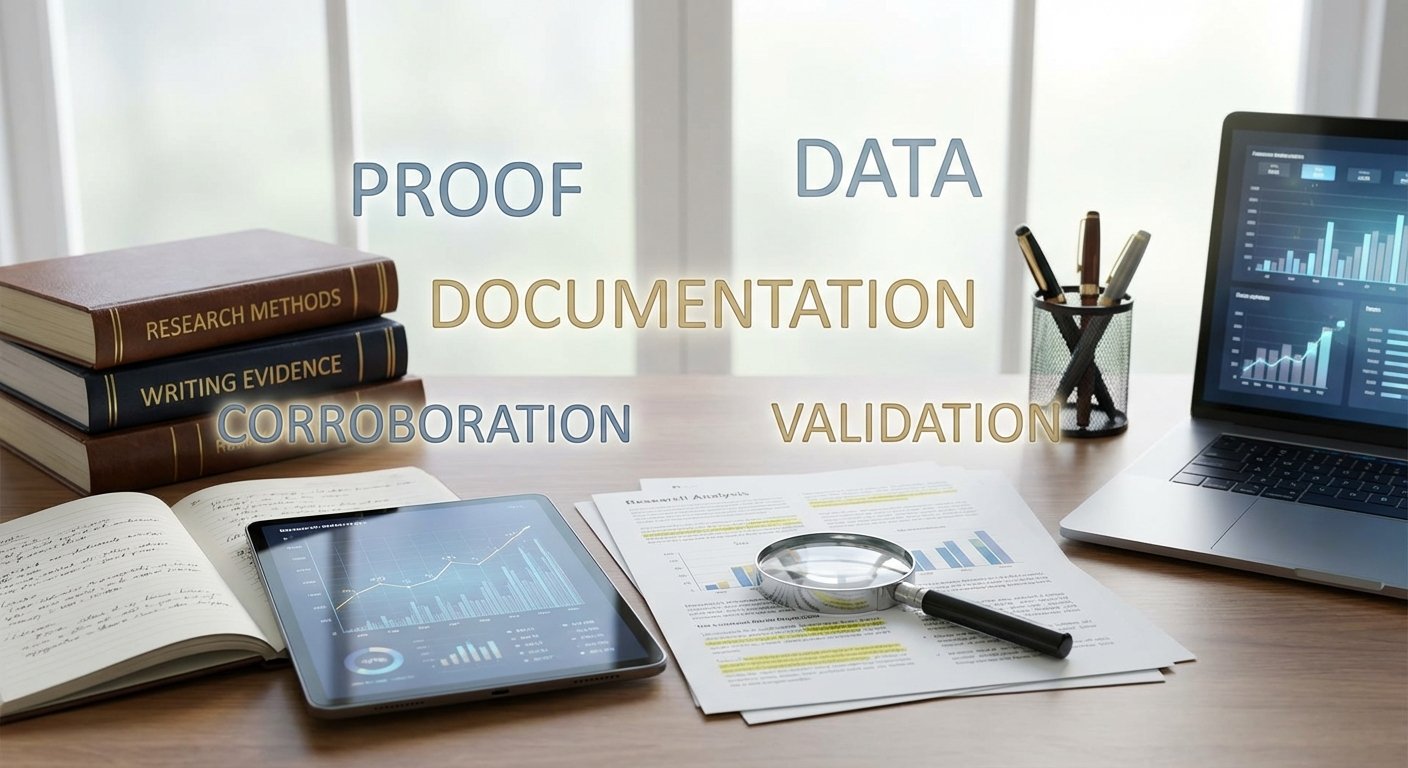
- Proof – Strong confirmation of a claim.
Example: “The experiment provides proof that the new drug is effective.” - Data – Numerical or factual information.
Example: “Data from the survey supports the hypothesis.” - Documentation – Recorded evidence.
Example: “The documentation confirms the process was followed correctly.” - Corroboration – Evidence that strengthens a statement.
Example: “Several studies offer corroboration for the theory.” - Validation – Evidence that confirms accuracy.
Example: “The results provide validation for the research model.” - Substantiation – Solid proof for an argument.
Example: “Substantiation of the claims is found in historical records.” - Confirmation – Evidence that establishes certainty.
Example: “The test results provide confirmation of the hypothesis.” - Demonstration – Showing evidence through example.
Example: “The lab demonstration confirmed the chemical reaction.” - Illustration – Example clarifying a point.
Example: “This illustration shows the correlation between age and memory loss.” - Empirical support – Proof based on observation or experiment.
Example: “The theory has strong empirical support from multiple experiments.”
Legal & Formal Contexts
- Testimony – Evidence provided by a witness.
Example: “The witness testimony supported the prosecution’s case.” - Exhibit – Document or object used as evidence in court.
Example: “Exhibit A proves the defendant’s presence at the scene.” - Attestation – Official confirmation of authenticity.
Example: “The attestation certifies the documents are genuine.” - Authentication – Verification of validity.
Example: “Authentication of the signatures confirmed their legitimacy.” - Certification – Formal confirmation.
Example: “The certification serves as evidence of completion.” - Verification – Establishing truth.
Example: “Verification of the data is required before publication.”
Everyday & General Writing
- Sign – Indication of something.
Example: “The dark clouds were a sign of an approaching storm.” - Indication – Suggestion that something is true.
Example: “The increase in temperature is an indication of climate change.” - Clue – Hint pointing toward evidence.
Example: “The footprints were a clue to the suspect’s identity.” - Trace – Small remnant proving occurrence.
Example: “A trace of chemicals indicated contamination.” - Mark – Physical sign proving an event.
Example: “The scratch on the floor is a mark of the furniture being moved.” - Token – Symbolic proof.
Example: “The medal was a token of her achievement.” - Hint – Subtle indication.
Example: “The tone of his message provided a hint of frustration.”
Specialized & Research Terms
- Finding – Conclusion from research.
Example: “The study’s findings support the hypothesis.” - Observation – Evidence gathered by watching.
Example: “Direct observation confirmed the animal’s behavior.” - Record – Documented evidence of events.
Example: “The patient’s medical record provides evidence of treatment.” - Fact – Verified and objective truth.
Example: “It is a fact that water freezes at 0°C.” - Statistic – Numerical representation of evidence.
Example: “Statistics show that 60% of people prefer online shopping.” - Case study – Detailed investigation.
Example: “The case study provides evidence of effective teaching methods.” - Example – Specific instance illustrating a point.
Example: “For example, the study of penguins demonstrates social behavior.” - Instance – A particular occurrence serving as proof.
Example: “This is an instance of early intervention preventing illness.” - Excerpt – Part of text providing proof.
Example: “An excerpt from the novel illustrates the author’s theme.” - Quotation – Cited statement proving a point.
Example: “The quotation from the article supports the argument.”
Advanced & Formal Alternatives
- Manifestation – Clear demonstration.
Example: “The protest was a manifestation of public dissatisfaction.” - Exemplification – Illustration through example.
Example: “Her project is an exemplification of innovation.” - Corroborative proof – Additional supporting evidence.
Example: “The witness statement serves as corroborative proof.” - Substantiating material – Concrete supporting evidence.
Example: “Substantiating material was provided to validate the research.” - Supporting documentation – Documents confirming claims.
Example: “Supporting documentation proves eligibility.” - Analytical data – Evidence from analysis.
Example: “Analytical data confirmed the chemical composition.” - Verified source – Trusted evidence.
Example: “The statistics come from a verified source.” - Observation record – Documented observations.
Example: “Observation records indicate consistent behavior.” - Demonstrative evidence – Visual or practical evidence.
Example: “The video serves as demonstrative evidence.” - Probative material – Legally significant evidence.
Example: “Probative material is presented in court to support the claim.” - Confirmatory information – Data confirming statements.
Example: “Confirmatory information validates the initial report.” - Physical evidence – Tangible proof.
Example: “The fingerprints are physical evidence of the crime.”
Tips for Using Evidence Synonyms Correctly in Sentences
- Match the synonym to context: Legal writing requires formal terms, while casual writing allows simpler words.
- Avoid overcomplicating: Don’t use highly technical synonyms if the audience is general.
- Provide clarity: Always clarify what type of evidence you are referring to.
- Balance variety: Mix formal and general synonyms to keep sentences readable.
Example:
- Weak: “The evidence shows that the program works. The evidence also indicates improved outcomes.”
- Strong: “The data shows that the program works. Additionally, the findings indicate improved outcomes.”
Common Mistakes When Using Evidence Synonyms
- Informal synonyms in formal writing: Avoid using “clue” in research papers.
- Misinterpreting synonyms: “Proof” implies certainty; “indication” suggests possibility.
- Keyword stuffing: Overusing “evidence synonym” reduces readability.
FAQs About Evidence Synonyms
1. What is a good evidence synonym for academic papers?
Answer: Terms like empirical support, corroboration, substantiation, validation, and documentation are ideal.
2. Can “proof” replace “evidence”?
Answer: Yes, but only when the claim is certain. Evidence may be suggestive, while proof implies absolute confirmation.
3. Which synonym is best for legal writing?
Answer: Use testimony, exhibit, attestation, authentication, or probative material depending on the context.
4. Are “clue” and “sign” acceptable in research papers?
Answer: No, these are informal and better suited for everyday or general writing.
5. How can I use multiple evidence synonyms effectively?
Answer: Alternate formal and general synonyms, and ensure each matches the context of the sentence.
6. Can evidence synonyms improve SEO content?
Answer: Yes, using natural alternatives like “proof,” “data,” “documentation” avoids keyword stuffing while targeting “evidence synonym.”
7. How many evidence synonyms should I use in one article?
Answer: For a 2000-word article, 10–15 synonyms are sufficient to maintain variety without confusing readers.
Conclusion
Using evidence synonyms effectively elevates your writing, whether in academic research, professional reports, or everyday communication. With over 50 alternatives, you can diversify your language, maintain clarity, and engage your audience.