


Table of contents
- Why the 1:7 Rule Is Wrong
- Cat Years to Human Years: The Formula
- Complete Cat Age Chart vs Human Years
- Life Stages of a Cat
- Why Cats Age Faster Than Humans
- Indoor vs Outdoor Cat Lifespan
- Breed Matters Too
- Signs Your Cat Is Aging
- Caring for Cats at Every Age
- Common Myths About Cat Aging
- FAQs: Cat Years to Human Years Formula
- 1. How old is my 2-year-old cat in human years?
- 2. How old is a 10-year-old cat in human years?
- 3. Do cats age faster than dogs?
- 4. Is 15 years old considered old for a cat?
- 5. Do indoor cats live longer?
- 6. What is the oldest cat ever recorded?
- 7. When should I switch to senior cat food?
- 8. How can I tell my cat’s age if adopted?
- Final Thoughts
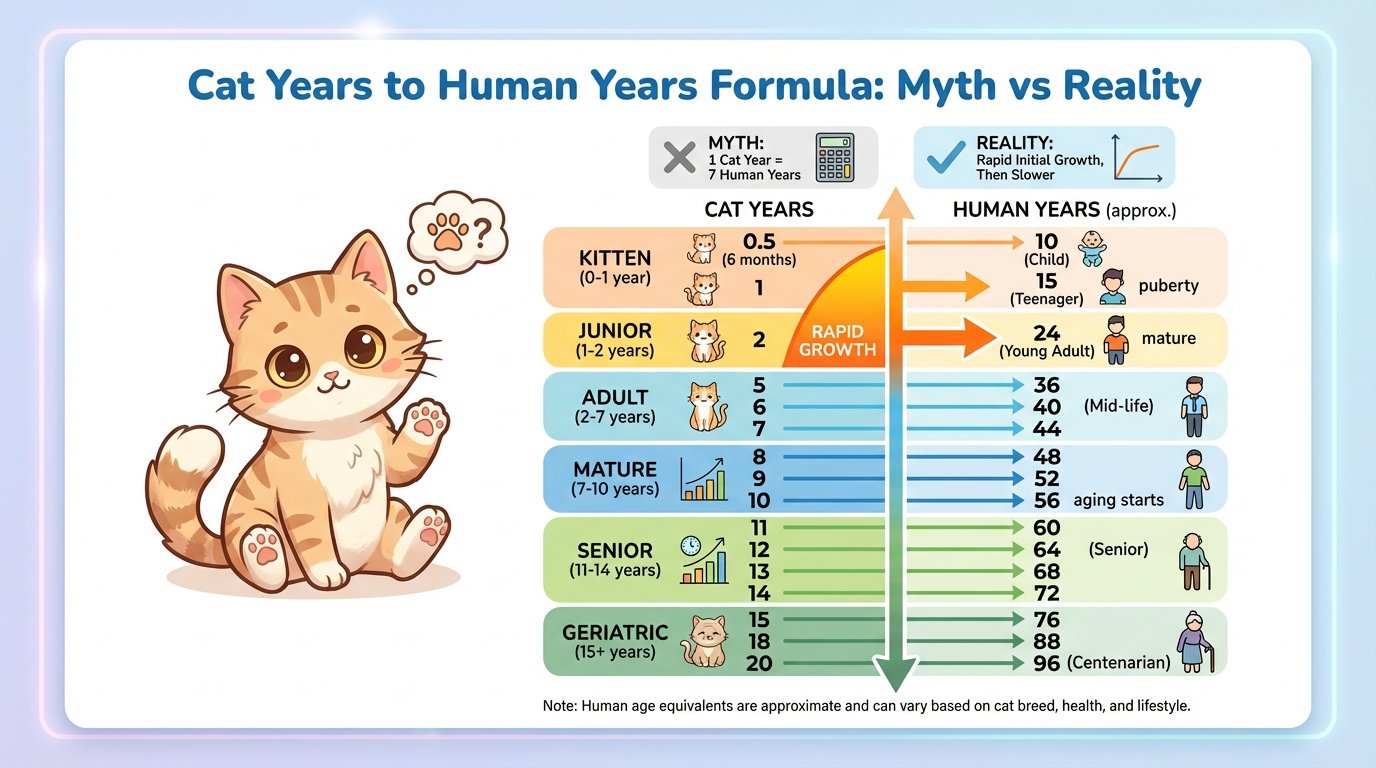
Many cat owners wonder, “How old is my cat years to human years ?” The simple answer, often heard as the “one cat year equals seven human years” rule, is actually a myth. Modern veterinary science shows that cats age differently, and understanding their aging process is key to keeping them healthy and happy throughout life.
This article explains the real formula for converting cat years to human years, explores the myths and truths, breaks down life stages, and provides a complete age chart for easy reference.
Why the 1:7 Rule Is Wrong
The popular belief that one cat year equals seven human years comes from a simplified estimate comparing average cat lifespans to human lifespans. While convenient, it ignores how cats develop rapidly in their first two years and age more slowly afterward.
The Real Aging Process
- First year: Cats reach sexual maturity and grow to full size—equivalent to 15 human years.
- Second year: Cat development slows but still significant—equals 24 human years.
- After year two: Each additional year ≈ 4 human years.
This shows why kittens grow fast and why senior cats need special care earlier than owners might think.
Cat Years to Human Years: The Formula
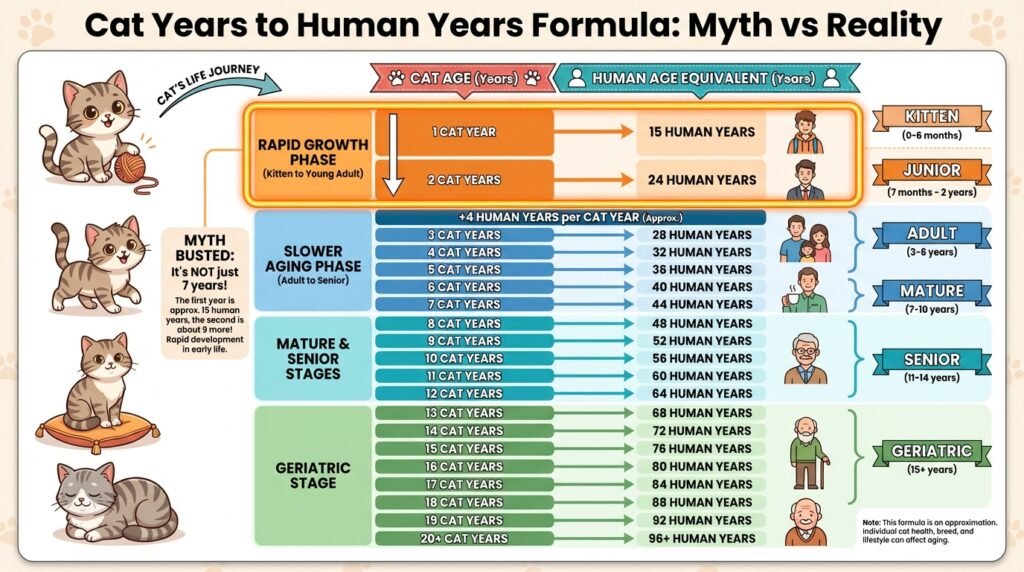
Veterinarians suggest a more accurate formula for estimating human age equivalents of cats:
For cats under 2 years old:
- 1 cat year = 15 human years
- 2 cat years = 24 human years
For cats over 2 years old:
- Human age ≈ 24 + (cat age − 2) × 4
Example:
- 5-year-old cat: 24 + (5 − 2) × 4 = 24 + 12 = 36 human years
Complete Cat Age Chart vs Human Years
| Cat Age | Human Equivalent |
|---|---|
| 1 month | 1 year |
| 3 months | 4 years |
| 6 months | 10 years |
| 1 year | 15 years |
| 2 years | 24 years |
| 3 years | 28 years |
| 4 years | 32 years |
| 5 years | 36 years |
| 6 years | 40 years |
| 7 years | 44 years |
| 8 years | 48 years |
| 9 years | 52 years |
| 10 years | 56 years |
| 11 years | 60 years |
| 12 years | 64 years |
| 13 years | 68 years |
| 14 years | 72 years |
| 15 years | 76 years |
| 16 years | 80 years |
| 17 years | 84 years |
| 18 years | 88 years |
| 19 years | 92 years |
| 20 years | 96 years |
Life Stages of a Cat
Understanding a cat’s life stages helps owners provide the right care.
1. Kitten (0–6 months)
- Rapid growth and learning
- Equivalent to human infancy/early childhood
- Needs vaccinations, socialization, proper nutrition
2. Junior (7 months–2 years)
- High energy and curiosity
- Comparable to human teenage years
- Ideal for training and bonding
3. Adult (3–6 years)
- Stable personality
- Peak health
- Equivalent to late 20s–early 40s in humans
4. Mature (7–10 years)
- Activity may slow
- Preventive veterinary care becomes essential
- Human equivalent: middle age
5. Senior (11–14 years)
- Possible arthritis, dental issues, or weight changes
- Needs senior-specific nutrition
- Human equivalent: 60–70 years
6. Geriatric (15+ years)
- Requires extra comfort, frequent vet visits, and monitoring
- Human equivalent: 76+ years
Why Cats Age Faster Than Humans
Cats age faster due to:
- Rapid early growth
- High metabolism
- Earlier sexual maturity
- Cellular aging differences
By the time a cat is one year old, it’s already a teenager in human terms.
Indoor vs Outdoor Cat Lifespan
Lifestyle impacts cat aging significantly.
Indoor Cats
- Lifespan: 12–18 years
- Safe from accidents, predators, and disease
- Age more slowly
Outdoor Cats
- Lifespan: 5–10 years
- Higher risk of accidents and infections
- Age faster due to stress
Breed Matters Too
Some cat breeds naturally live longer:
- Siamese: 15–20 years
- Ragdoll: 12–17 years
- Maine Coon: 10–15 years
- Persian: 12–16 years
- Mixed breeds: Often live longer
Genetics play a role, but nutrition and care matter most.
Signs Your Cat Is Aging
Common signs of aging:
- Reduced activity or jumping ability
- Weight gain or loss
- Increased sleep
- Cloudy eyes
- Dental issues
- Litter box changes
Early detection helps improve longevity and quality of life.
Caring for Cats at Every Age
Nutrition
- Kittens: High-protein growth food
- Adults: Balanced diet
- Seniors: Joint support, low calories, easy-to-digest
Exercise & Play
- Interactive toys
- Short play sessions for seniors
- Mental stimulation prevents cognitive decline
Veterinary Care
- Annual checkups for young cats
- Biannual for seniors
- Blood tests detect early disease
Common Myths About Cat Aging
❌ Myth: 1 cat year = 7 human years
✅ Truth: Cats age rapidly early, then slower
❌ Myth: Old cats can’t learn
✅ Truth: Senior cats can adapt and learn
❌ Myth: Aging cats don’t need play
✅ Truth: Mental stimulation is important at all ages
FAQs: Cat Years to Human Years Formula
1. How old is my 2-year-old cat in human years?
A 2-year-old cat ≈ 24 human years.
2. How old is a 10-year-old cat in human years?
A 10-year-old cat ≈ 56 human years.
3. Do cats age faster than dogs?
Yes, cats mature faster in the first 2 years.
4. Is 15 years old considered old for a cat?
Yes, it’s senior/geriatric, similar to a 76-year-old human.
5. Do indoor cats live longer?
Yes, often twice as long as outdoor cats.
6. What is the oldest cat ever recorded?
38 years, over 160 human years equivalent.
7. When should I switch to senior cat food?
Usually around 7–10 years, depending on health.
8. How can I tell my cat’s age if adopted?
Veterinarians estimate age using teeth, eyes, coat, and muscle tone.
Final Thoughts
The cat years to human years formula helps owners understand and anticipate their cat’s needs. Cats age quickly in the first 2 years, then more gradually, making nutrition, play, and veterinary care essential at every stage.