Table of contents
- Introduction
- National Overview: Physical Therapist Salary in 2025
- Top Paying States for Physical Therapists
- States with Moderate to Lower Average Salaries
- Factors Affecting Physical Therapist Salary
- State-by-State Physical Therapist Salary Snapshot (2025 Estimates)
- Cost-of-Living Adjusted Salaries
- Career Growth and Salary Trends
- Tips for Maximizing Physical Therapist Salary
- FAQs
Introduction
Physical Therapist Salary is one of the fastest-growing professions in healthcare. With an aging population, increasing awareness of preventive care, and demand for rehabilitation services, physical therapists are in high demand across the United States. But how much do physical therapists actually earn in 2025, and how does salary vary from state to state?
In this comprehensive guide, we’ll break down average PT salaries by state, explore what factors affect pay, and provide tips for aspiring and practicing physical therapists. We’ll also answer frequently asked questions to help you navigate this career path.
National Overview: Physical Therapist Salary in 2025
According to the U.S. Bureau of Labor Statistics (BLS), the median annual salary for physical therapists in 2024 was $101,020, with projections for 2025 suggesting similar or slightly higher averages (around $102,500).
Salary ranges vary significantly based on experience, specialization, employment setting, and geography:
- Entry-level PTs: Approximately $75,000–$85,000/year
- Mid-career PTs (5–10 years): Around $95,000–$105,000/year
- Experienced PTs (>10 years): $110,000–$120,000/year or more, especially for specialized or private-practice roles
It’s important to note that salaries in some states exceed the national average due to high cost-of-living and strong demand, while others fall below the national average but may offer lower living costs.
Top Paying States for Physical Therapists
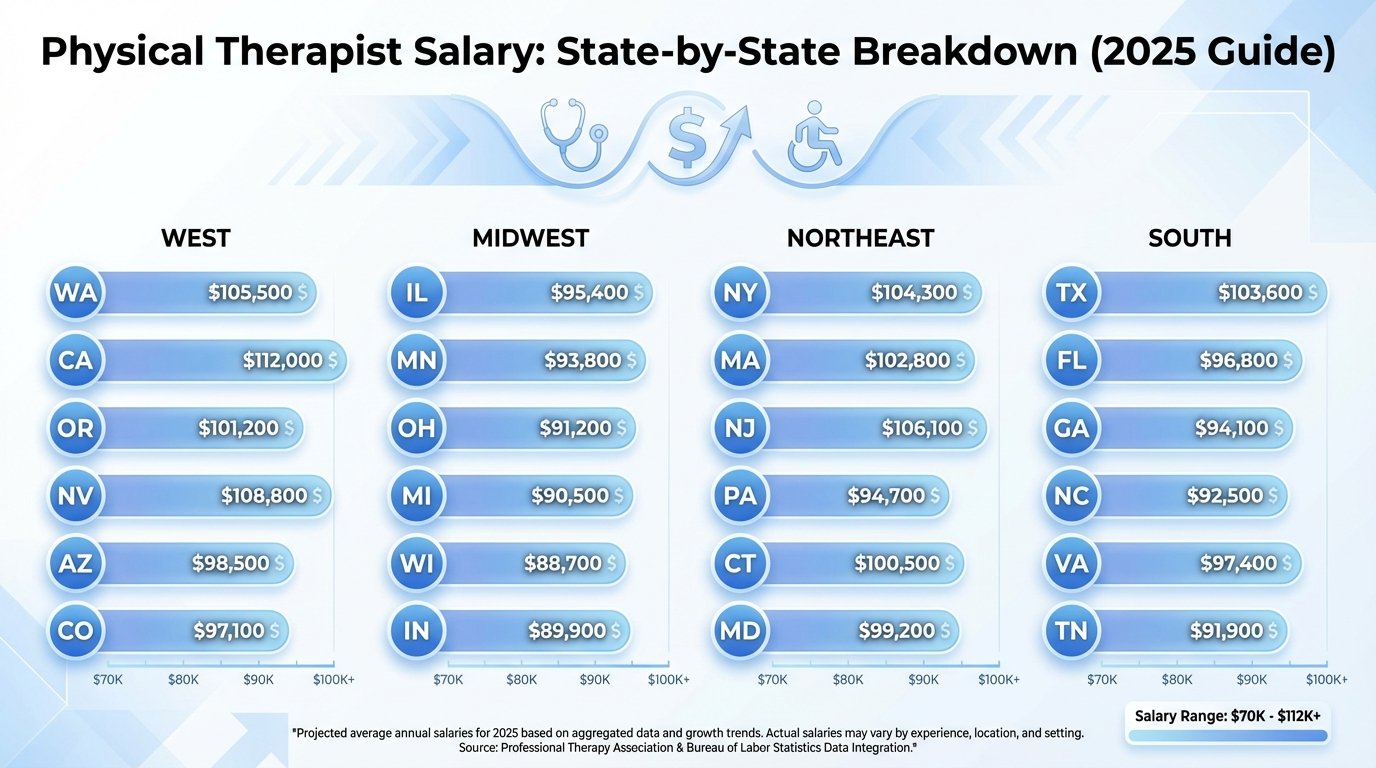
The states with the highest average PT salaries often have high living costs or significant demand for healthcare services. Here’s a breakdown for 2025:
| Rank | State | Average Annual Salary | Notes |
|---|---|---|---|
| 1 | California | $114,270 | High demand in urban centers like Los Angeles and San Francisco; cost-of-living is high. |
| 2 | Nevada | $111,460 | Las Vegas and Reno have growing rehab centers. |
| 3 | Alaska | $110,830 | Limited PTs relative to population; remote location increases pay. |
| 4 | New Jersey | $109,280 | Dense population, high demand for outpatient and hospital PTs. |
| 5 | Texas | $106,960 | Growing population and healthcare infrastructure; moderate living cost. |
Why these states pay more:
- High cost-of-living: Employers compensate for expensive housing, transportation, and living expenses.
- Demand vs. supply imbalance: States with fewer PTs relative to patient demand tend to offer higher salaries.
- Healthcare infrastructure: Large hospitals, specialty rehab centers, and insurance reimbursement policies influence pay.
States with Moderate to Lower Average Salaries
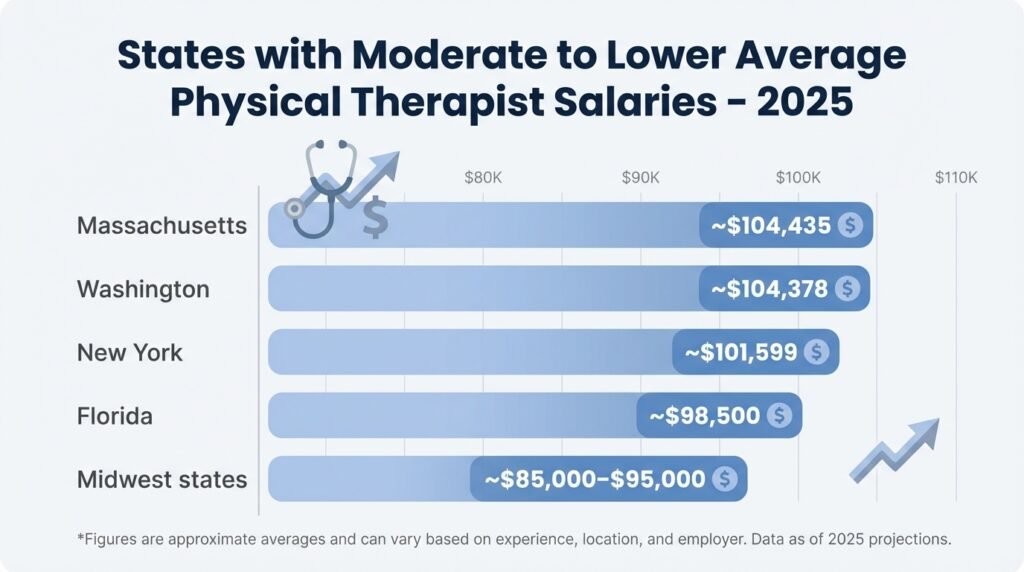
While some states top the charts, others offer moderate salaries. These are often balanced by lower living costs:
- Massachusetts: ~$104,435/year
- Washington (state): ~$104,378/year
- New York: ~$101,599/year
- Florida: ~$98,500/year
- Midwest states (e.g., Iowa, Nebraska, South Dakota): $85,000–$95,000/year
Key considerations:
- Lower salary states often have smaller cities with fewer hospitals or outpatient centers.
- Cost-of-living adjustment is crucial — $90,000 in Iowa may provide a higher standard of living than $110,000 in California.
Factors Affecting Physical Therapist Salary
Salary isn’t only about the state; other factors significantly impact earnings.
1. Experience and Career Stage
- Entry-level PTs earn less, typically between $75,000–$85,000.
- Mid-career PTs with 5–10 years of experience can expect $95,000–$105,000.
- Senior PTs with over a decade of experience, specializations, or managerial roles may earn $110,000–$120,000+.
2. Specialization
PTs specializing in areas like orthopedics, sports rehabilitation, neurology, or geriatrics can command higher salaries due to increased expertise.
3. Employment Setting
- Hospitals and large rehab centers: Higher average pay due to volume and complex cases.
- Outpatient clinics: Moderate pay; may offer flexible hours.
- Home health agencies: Often higher pay per visit due to travel and independent work.
- Private practice owners: Income varies widely based on client base and business management.
4. Geography & Cost of Living
High-paying states often coincide with high living costs. Salary must be evaluated alongside housing, taxes, and daily expenses.
5. Demand & Workforce Shortages
Some states experience a shortage of qualified PTs, which drives salaries higher. Conversely, areas with abundant PTs may see stagnating wages.
State-by-State Physical Therapist Salary Snapshot (2025 Estimates)
| State | Average Annual Salary |
|---|---|
| California | $114,270 |
| Nevada | $111,460 |
| Alaska | $110,830 |
| New Jersey | $109,280 |
| Texas | $106,960 |
| Massachusetts | $104,435 |
| Washington | $104,378 |
| New York | $101,599 |
| Florida | $98,500 |
| Illinois | $97,300 |
| Ohio | $95,200 |
| Pennsylvania | $94,800 |
| Michigan | $93,500 |
| Iowa | $90,000 |
| Nebraska | $89,500 |
| South Dakota | $87,500 |
| Montana | $86,200 |
| Kentucky | $85,700 |
| Idaho | $85,500 |
Cost-of-Living Adjusted Salaries
When comparing states, it’s essential to consider purchasing power. For example:
- $114,270 in California may have equivalent spending power to $92,000 in Texas due to higher housing and living costs.
- $87,500 in South Dakota may afford a comfortable lifestyle because housing and expenses are lower.
PTs should evaluate salary vs. living costs before relocating for a job.
Career Growth and Salary Trends
- Projected growth: Physical therapy employment is expected to grow 11% from 2024–2034, faster than the average for all occupations.
- Factors driving growth: Aging population, chronic disease management, preventive care, and post-surgical rehabilitation.
- Future pay trends: States with shortages may see salaries increase, while oversupplied markets may have slower growth.
Tips for Maximizing Physical Therapist Salary
- Pursue specialization: Advanced certifications can boost earning potential.
- Consider relocation: Moving to high-demand states can significantly increase salary.
- Negotiate based on experience and setting: Hospitals and home-health positions often pay more.
- Leverage telehealth & hybrid PT: Expands patient reach and may increase income.
- Continuous education: Stay updated with new therapies and techniques to remain competitive.
FAQs
A: The national average is around $102,500/year, though it varies by state, experience, and setting.
A: California tops the list at ~$114,270/year, followed by Nevada and Alaska.
A: Not necessarily. Cost-of-living adjustments mean $87,500 in South Dakota may provide a similar lifestyle to $114,000 in California.
A: Specializations like orthopedics or sports therapy can increase salary by $5,000–$15,000 annually, depending on the state and demand.
A: Private practice can be more lucrative if the PT builds a strong client base but carries business risks. Hospitals offer stability but may have lower maximum salaries.
A: Entry-level PTs earn ~$75K–$85K, mid-career PTs $95K–$105K, and senior or specialized PTs $110K–$120K+.
Conclusion
Physical therapist salary in 2025 vary significantly by state, experience, specialization, and work setting. High-paying states like California and Nevada offer lucrative opportunities, but cost-of-living adjustments are important to consider. Aspiring PTs should weigh location, career growth opportunities, and specialization to maximize income potential.
By understanding the state-by-state breakdown and strategic career planning, PTs can make informed decisions to secure rewarding and financially stable positions in 2025 and beyond.